
I sat down with Foroozan Talei Fard on September 25th, 2025 in their studio space at Medalta International Artists in Residence, in Medicine Hat, Alberta. She was preparing for her final atmospheric firing, as her residency was coming to and end in just a few short days. It was bittersweet to get to speak with her so close to the end of the residency, but it became clear that a month can be a deeply enriching and invigorating time. I am thankful to Foroozan for their grace and openness during our interview, make sure to check out their instagram which is linked at the bottom of this interview.
A- So who are you and why do you make?
F- My name is Foroozan Talei Fard. I am a Canadian Persian Vancouver based artist, and I’m proud of my nationality. I’m human. And I always considered myself an artist.
A- You’ve always thought of yourself as an artist?
F- I grew up in a family where my mom, my aunts, everyone knows how to sew. Although sewing is considered craft, for me, it’s art. I learned how to sew when I was six. I started sewing some small pieces with my tiny hands for my dolls. I really was eager to learn. Whenever my mom was sewing, I sat down beside her and just looked at her hands. It was never a doubt for me that I have to be an artist. I think art is in my blood.
A- And passed down, through your mother, it sounds like. Did your grandmother do any sewing as well?
F- My grandma, from my mom’s side, passed away when I was six or five. I don’t remember, but my aunts, on both sides, were sewers. And my grandmother on my father’s side was a weaver.
A- A weaver, wow.
F-I told you that I did some weaving, and I didn’t know how, but anyway, it was in my genes.
A- There’s a familial lineage of women makers and artists in your family
F- Exactly.
A- Do you feel like this is why you make art today is because of that familiar lineage? Or are there other driving forces that are making you make art?
F-I don’t know, this is a hard question, but I have always felt that I have to do something with my hands. I have to create something, and it should be 3D mostly, not 2D. I did lots of paintings and drawings, but none of satisfies me like sculptures. Let’s talk about my paintings. They are not flat. They have some texture… So, they are somehow 3D.
A- Even your paintings wanted to come out into space.
F- Exactly. In college, when I had the sculpture course, I found out how good I am at sculpture and in general at 3D forms. I remember the first time that I touched clay. Touching clay was satisfying and calming. Working with clay is relaxing and it is constant therapy for me. I enjoy touching clay and making something but it’s not just about making- it’s about the feeling. Maybe it’s because of the earthy material. I can’t imagine a day with no clay in my life.
A- Do you rest on that day of no clay?
F- Yeah. Sometimes I have me-time. In my me-time day, I visit galleries, shop, and eat by myself. And here (at Medalta), it was one month of me-time, for me. It was one month me-time.
A- That is a great way to describe this experience. It’s one month where you’ve travelled away from home, from Vancouver, and now your whole life revolves around the studio for this period of time.
F- Exactly- I don’t have anything to worry about, I don’t have any obligation, I don’t even think about work. Should I go to work? Should I cook? I cook here. But it doesn’t matter if I cook or not. Every day when I come here, I enjoy my day.
A- That’s wonderful. I feel like I hear that same sentiment from many residents. Has the studio environment here at Medalta influenced or changed the work you’ve started while being here?
F- I had a plan when I came here, and I started really with the three big ones (sculptures). I did some sketches before I came here. I didn’t want to come here with no plan. But after a while, some of the plans changed. I originally wanted to make six pieces. When I’m in Vancouver I don’t own a studio, I had a (studio) membership but it’s different. You can’t really focus on your pieces. For the first week, I was so fast. So, I had to plan for more pieces. Being here among other artists is inspiring and encouraging to do more. I really enjoy being in the studio. That’s the environment where the artists talk to each other, they are so friendly, they exchange their knowledge, that’s important here. I believe that’s what this studio has.
A- Yeah, that’s something special here is that it’s a proximal learning environment where you’re not really taking a class, but you get to soak up and observe all of these different ways of making.
F- For me, it’s one month of nonstop learning. Even though no one is teaching something, as you said. We are observing and getting knowledge from each other.
A- What’s the energy been like in the studio?
F- Oh, it’s really good. And I think I was lucky to be among a great group. I don’t know if it’s always like that, but anyway, for me, it was really great experiment.
A- I’m so glad to hear that. That makes all the difference. What’s the biggest studio surprise that you feel like you’ve encountered here at Medalta?
F- Good or bad? Which one?
A- Whichever you want to share.
F- Yeah. So, the equipment and everything is really good, and on the website, there was a good advertisement for the facilities. We have an expression in Persian. “Sweeping everything under the carpet.”
A- Oh, yes, sweeping something under the rug.
F- In this studio, everything is so clean, so tidy. Not everything is new, which is okay. But I didn’t expect to go outside beside the salt and soda kiln and see bunch of garbage. I’m sorry I had to tell you this.
A- You can be critical, that’s ok.
F- You know, it’s a bunch of garbage, right? In the first day, I told myself. Is this part of Medalta?! Yeah. It is.
A- Like out on the kiln pad?
F- Yeah, it’s Medalta. Everything here is tidy, everything.
A- The kiln pad is the rug. Yeah, exactly.
F- You see the kilns and then you suddenly see oh what’s this? Is it storage? It’s not. What is it? I don’t care about the other side or whatever. They left some other pieces, but it’s not good. They should remove it from here. These are not part of the historical section that we should not touch.
A- Yeah, I can see why that really stood out to you.
F- Yeah, I didn’t like it.
A- You kind of touched on how you were able to make so much more than you thought. What was the biggest surprise that took place inside your studio for you?
F- In week one, I made those three big ones, and it wasn’t really easy. I did a lot of carving. And I want to do more carving. The amount of work that I have done, and the quality of the work in such a short time surprised me.
A- Can you describe the pieces that you were working on? What was the motivation behind the work and how did you build it?
F- So the motivation was from a few years ago when I went to Emily Carr’s library, and I wanted to find some books on Persian ceramics, but I couldn’t find any. I needed some inspiration. And it was a bit disappointing.
A- Strange. There’s a really rich history of Persian ceramics.
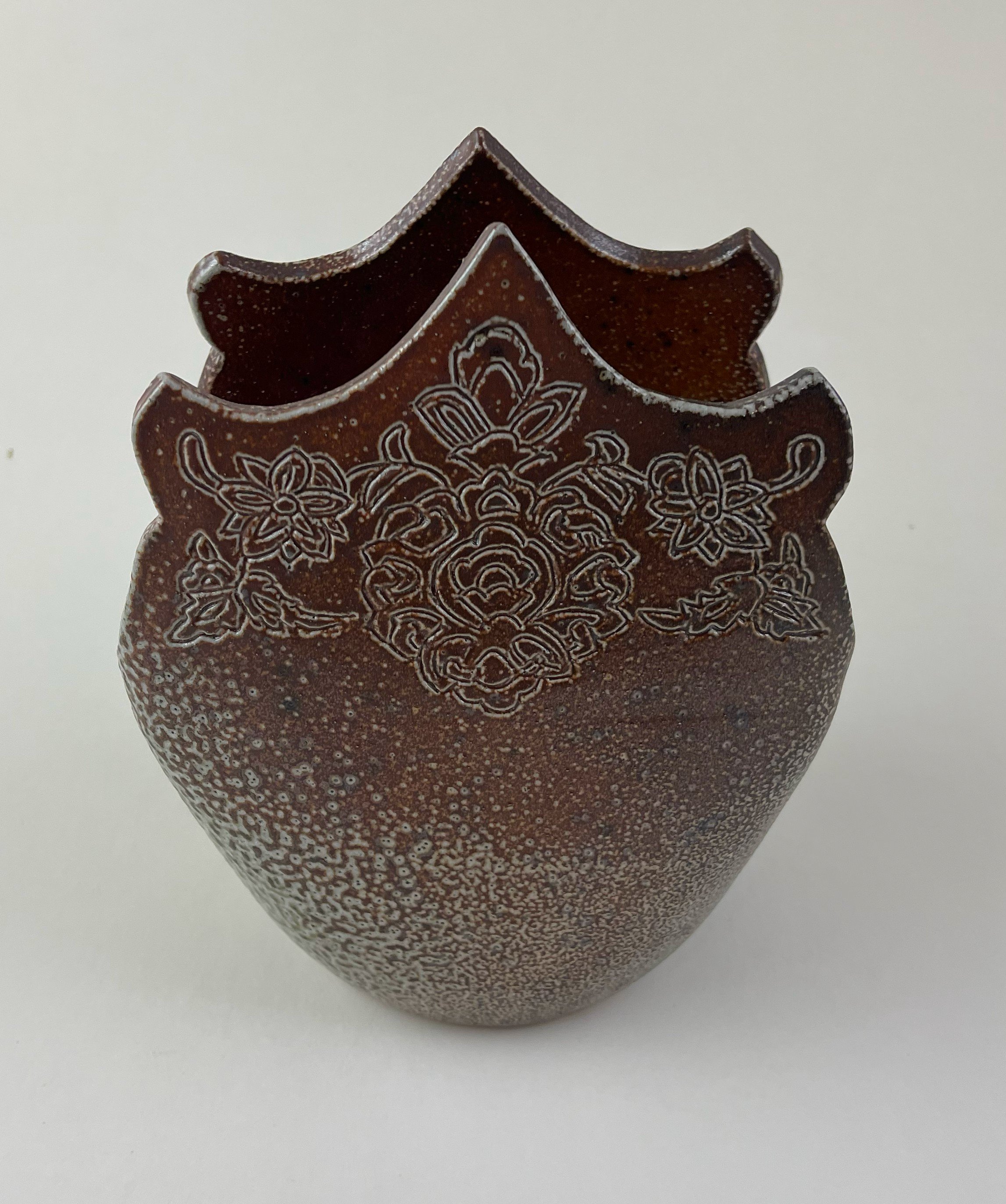
F- Exactly. And recently, there is a book that you can find on Amazon, and it’s a really good one. That’s when my practice really shifts. I had a trip to Iran to visit my family, and I visited Glassware and Ceramic Museum of Iran in Tehran, I took some pictures over there. I have got some inspiration from Ceramic shapes and their motifs. I brought some good books from Iran. And that was the beginning of making works based on Persian art. I didn’t want to copy them. I wanted to bring the form and shapes to my practice. I found out that as an artist I have a voice, I want to pass some knowledge about Persian arts and Persian ceramics here. Art is like a window, a door that people can look at and enjoy or learn something from it. So that was the time that I shifted to Persian art. It was in my last year of school that I started to make tiles and combine them with textiles. I made a vest, the top part was made of small tiles, and the bottom part was a weaving piece using the floor loom. All my works, after that, is about me as a woman, as a person that has a different background came here (Canada) and adapted, changed and welcome new thing in her life. For my recent pieces, I chose this book (Persian Decorative Designs in the Tile-Making Art). I used part of a tile design which originally designed for a large roof or wall.
A- Do you see your own self, your own voice being in conversation with this traditional tile work?
F- I like to bring the traditional tile into my works, but I’m not a traditional person. The forms that I’m making it’s not really the form that you can see in any of Persian traditional ceramics. Even these pieces, for instance, sort of tradition. It’s just using the pattern and design.
A- You can recognize the traditional Persian carving that’s happening on the works. But then the form itself, I think that’s where your voice gets louder.
F- I can tell they are all representing me. It shows that some part of me is gone. In this work, maybe this is some part of me. If this part is my tradition, this is myself in the past, and here, it’s me that is combined from Canadian and Persian culture. So, it’s not the form that you usually see.
A- Kind of a hybrid?
F- Hybrid, yeah. And even this one, you can see that this part is blank and even bending a bit. So, it’s how flexible I am. I can be flexible and adapt myself to a new environment.
^image courtesy of the artist
A- There’s an interesting relationship between the interior and exterior of the form - it’s not completely closed. Do you think of these as vessels? Do you ever use that word in your practice or does that not feel right?
F- It’s just a sculpture. Yes, I’m doing some pieces that you can use. I make mugs, I make pieces for selling because I have to live. But even this one (sculptural form) can be used, but it’s not my purpose.
A- Yeah, it doesn’t have a strictly utilitarian functionality to it.
F- But it holds something.
A- Are there any specific ceramic processes that you use in your practice and do these hold any conceptual significance for you? Are there reasons why you choose to hand build compared to throwing an object?
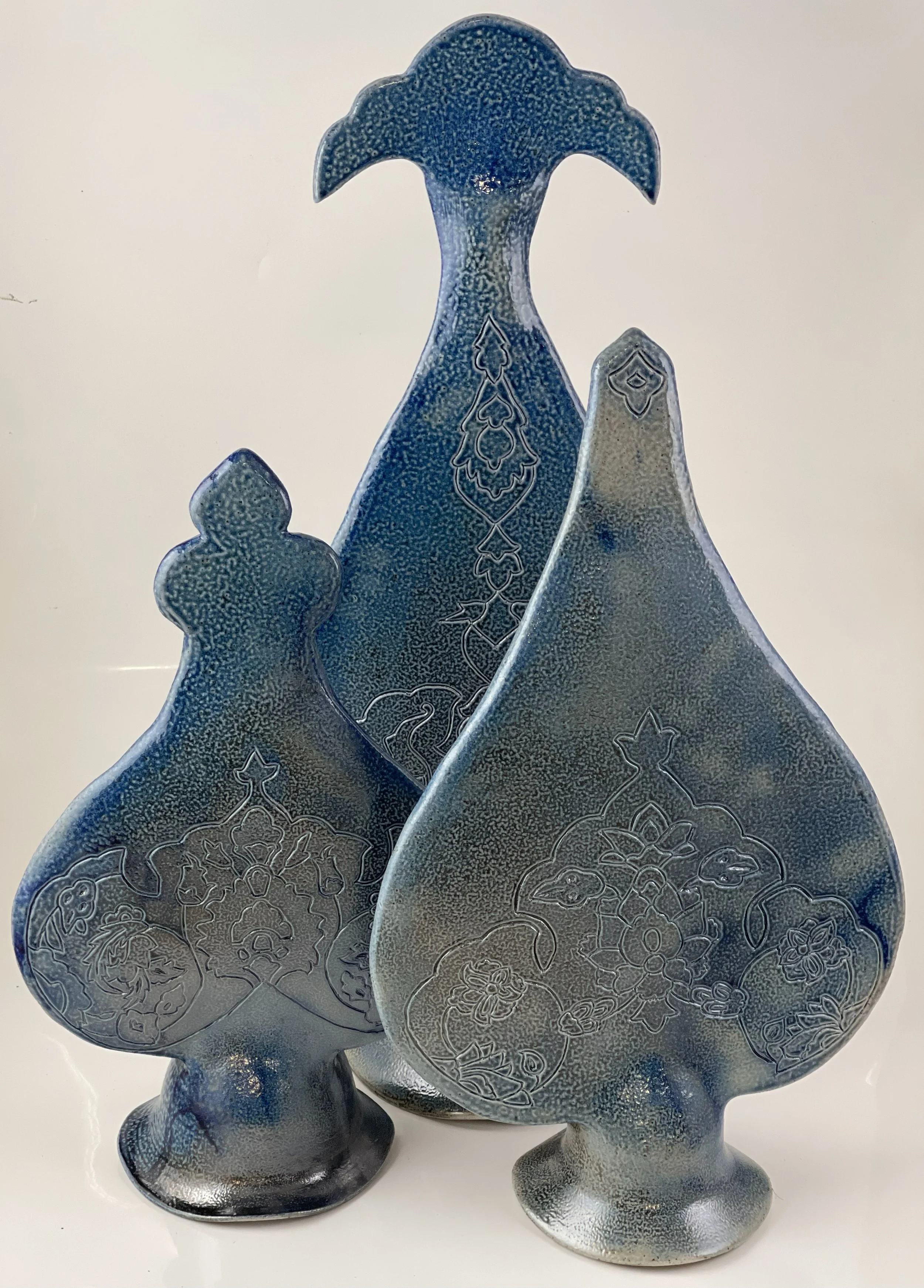
F- No. I enjoy combining hand building and throwing together. I like to make series, not multiples, but a series of objects. Three that go together, not the same shape, but they go together.
A- People usually describe a smaller object as being more intimate, compared to something large. Does intimacy play any role in your work?
F- Maybe it’s because we live in small apartments. We are in small spaces. Maybe that’s the reason. Maybe if I had a big studio, I’d start to make bigger pieces. But I want to practice throwing big vessels. Because it’s really challenging. I have to really do it. I hand built a three-foot piece before.
A- How do you know when a series is finished or when it’s done?
F- Usually I make two, three or four. Yeah, that’s a good question. Because when I made these three, I found that I don’t want to make anymore. It’s repetition. I don’t want to repeat something.
So, whenever I feel like this is a repetition, I just stop.
^ image courtesy of the artist
A- How do you see them when they’re together in the series? Are they singular individuals or is it more like a group having a conversation?
F- They are a group having a conversation. When I was in college, I had an exhibition that was 65 profile heads. It was during the pandemic. I made 65 plaster heads. Initially, I had to make +20 pieces, but I ended up making 65 head with some masks. They were exhibited on a long wall. The gallery had a window outside, so people didn’t need to come inside. The installation and arrangement of different masks was like a group of people in our new situation.
A- I feel that when you say that, it points towards intuition, or a gut feeling that is telling you when to stop. Do you feel that you have a voice inside of you when you are making and do you listen to what it says? Do you just trust it?
F- I am an emotional person. And I follow my heart, mostly. That is why I became an artist. I was working in an office. Once I felt that I have to quit, and I resigned. My boss tried to convince me to stay. At the end he asked me “why do you want to quit?” I told him, “I want to follow my passion. I don’t want to be trapped here, work every day in an office and go home after work like a machine”. I chose to earn less money. In Canada, I started my professional journey at NIC and on the first day my classmate asked me “why do you come to the college? You have a good job.” At the time, I was working at Vancouver Opera in costume shop. I told them, “I want to make art professionally. I want to explore more. I want to learn every day.” I have never stopped learning for a day in my life.
A- I think a lot of artists are really committed to being lifelong learners. I don’t know if researching is the right word but learning through making and materials.
F- That’s a kind of research, I can say. It’s a kind of test. For instance, when I made this piece, I had another plan. For the exterior part, I made four parts which didn’t work. I ended up to used three parts. That’s learning, I think. That’s where you see what is good and what is not good.
A- Yeah. I think that also points back to the adaptability that you were talking about before and how you have the capacity to change depending on the circumstances.
F- I’m a flexible person. I’m a patient person. It doesn’t mean that I forget who I am. No, there is a specific character that I have and I follow that. If something is reasonable, if something is good for me, I can change.
A-What are some of the biggest questions that you’re living with right now in your studio work? What are you asking yourself?
F- I know there is a lot to learn every day. And sometimes I doubt myself. Can I really do that? I mean can I do it perfectly. Because I’m a perfectionist.
A- What does it mean to be good at something? How do you define good?
F- Everything should be perfect. I sew a dress, if it’s puckered, I can’t stand it, I have to fix it. A long time ago when I started to paint, I also learned how to make frames. I remember I was making a frame and I tried to draw some perfect and neat flowers on it. My instructor told me, “Don’t make everything perfect- art isn’t going to be perfect. Art is not about perfection.”
A- Do you feel like that tendency towards perfectionism is connected to craft in any way?
F-Maybe. Maybe in craft, you have to be perfect, or maybe that’s the way I learned.
A- How do you think of, or define craft?
F- I have problem with this word “craft”. I did some knitting with paper clay. There were five different pieces that I attached them with yarn. The result was a big knitting piece which some parts made of clay and other parts of yarn. And that was when I wanted to debate that it’s art, not craft. Craft consider to be lower than art. So, I found out when something is functional and you spend a lot of time making it is craft. Wherever there is labour and hard work like making carpet or embroidery is craft. In case of embroidery, even a small piece, takes a lot of time.
A- And craft has such a long history of being associated and connected to women and women’s work.
F- Exactly. Good point. In our time, we hear that there’s no hierarchy, but there is. The world is man dominated. And most of the work that they say is craft, it’s women’s job.
A- Real. If you had all the facilities, time, means, money to make it happen, what is your unrealized project? As in, a dream project that you haven’t made, but you dream of making?
F- I lost my mom one and a half years ago. And since then, I’m trying to make a big project that is about her. I’m trying to make it happen. But this project is about me and my grief. It is about how I am now and how fragile I was. I am going to incorporate some silk into them which had belonged to my mom’s top. One day I want to celebrate her life, and I don’t know what the project will be, but it will be about her. That is something that I am going to do one day. Because whatever I have learned, it was from my mom. I started learning sewing from her, so everything is going to be about her.
A- That’s beautiful. I feel like a lot of what you were saying points to the importance of materials choices- I’m thinking of the silk of your mother’s top. What’s your relationship with the materials you work with?
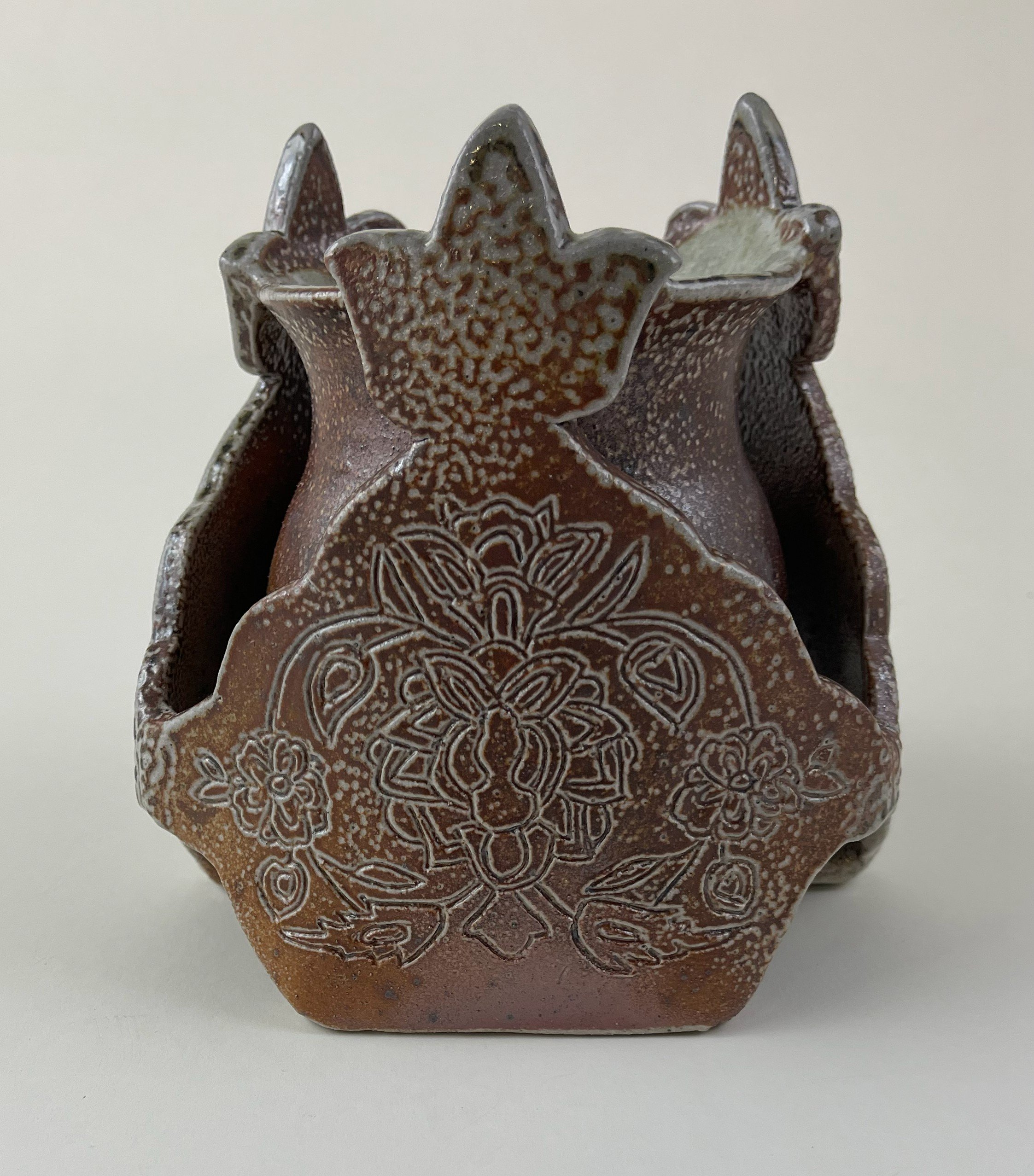
F- So I found out that I am a person that likes to touch everything. When I am working with clay or fabric, I am using my hands and touching the material.
A- There’s a different level of physical, tactile intimacy that comes with the sensory experience of touching materials directly. It documents your specific way of touching that material. So touch sounds very important to you.
F- Yes, yeah.
^image courtesy of the artist
A- Is there a question that you haven’t been asked that you really wish someone would ask you? Either from me or in general in your studio that you really wish someone would ask you about that you because you have like an idea and you just really want to talk about it and you’re just like, if only someone would ask me this question.
F- Oh, not really, because if there is anything I want to know I just ask.
A- There’s a lot of agency in that answer. I like that.
F- Yeah, I learned that I should not wait for someone to ask me. If I want something, I have to go and find it or I have to ask. Especially when you are a person who immigrated from another country, and you really don’t know all the aspects of the culture. If you just sit and listen, it’s not going to happen. This is not the culture in Canada. I learned that if you know something, you have to show and say that you have the qualification.
A- Yeah, you have to be explicit about the skills and abilities you have. And let people know they should trust that because you are telling the truth about yourself. So, what’s next for you after your residency here?
F- So I go back to my usual life. But I probably want to work on my portfolio for masters. And next year I have a Residency at the Shadbolt Centre. In November, one of my pieces is exhibited in Hamilton, Ontario. I have to prepare to ship that. The exhibition is at the Cotton Factory by NoBa. The exhibition is called Nature, Being, & Technology. It’s going to be November 7th until December 7th, with 29 international artists. It’s about using technology, textiles, in any way.
A- Many exciting things are coming up for you! Congratulations. Do you have any questions for me?
How are you feeling now that we’re at the end of our conversation?
F- It really was a conversation. I like that you gave others and me a chance to really express their feelings, express themselves, and its good to get to know artists better. They are not just their work; they have feelings and there is a lot behind the work.
A- The main goal is to get a glimpse into the inner world of the artists that are interested in talking to me. I think there’s a lot of really interesting stuff happening in the studios at Medalta, and I want people to know about it. Thank you so much for talking with me, Foroozan!
Links:
follow Foroozan on insta @foroozan.tf.studio
https://www.nobacontemporary.com/events/naturebeingtechnology