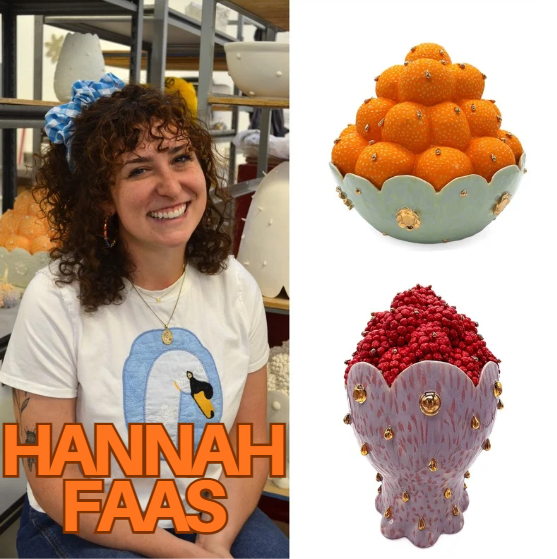
I invited myself into Hannah Faas’ studio space in September 2025 with the intention of picking their brain over how they think about their work, how they exist in the studio, what questions they’re living in right now, and what does it mean to be a maker in this day and age, amongst other things. Hannah was nearing the end of a one month long artist in residence position at Medalta International Artists in Residence program, located in Medicine Hat, Alberta.
A- Do you think you’re weird?
H- This is a question that I talk about my partner all the time where I feel I’m too weird for the normal people, but I’m too normal for the weird people. And then I’m in this weird in between where I don’t really feel I fit in either side.
A- I don’t know why I’m laughing. Sorry.
H- Because I used to be an accountant and I loved to go to art shows and those people all thought I was crazy. And then when people who are artists find out that I used to do that, that they were- oh! So it’s kind of this weird back and forth. I don’t know. I don’t know how weird I am.
A- I mean, it’s a hard question to answer. How do you feel about being in that in-between space?
H- It’s lonely sometimes for sure. I think that there’s some strength that comes with it where you can kind of walk in between both. Not that it’s so black and white, or so stereotypical. I don’t want to typecast artists as if nobody knows how to manage their time or in the more business/formal aspects of it. So it’s nice to be able to pull on that, but it’s also kind of lonely. I don’t really feel I fit either of those places.
A- So who are you, and why do you make?
H- I mean, I can start with the very generic - I’m somebody from Hamilton Ontario. I am a ceramic artist, but I’ve done other things as well. I feel many artists have had different careers. I could also do the answer of, I’m a daughter and a friend and a partner and all those other things because I don’t like just answering based on what I do. You know, you meet people and the first question is always, what do you do? And that sometimes bothers me because people aren’t just what they do. But then I also feel I’m a person who’s trying to understand what making art is when the world feels like it’s ending for lack of a better term, and what does that mean? And is that selfish or valuable? .
A-Those are really good questions.
H- Just get right to the doom and gloom.
A- I think those are very real questions. I think about those things a lot.
H- Exactly. When I first started making art I left a stable career where I had a salary, a predictable career path. I’ve worried that I was being selfish and I guess maybe financially or socially that was the driver for worrying about that. But , now I feel obligated in some way to help or try to make sense of it, but I don’t really know how to do that. And then that comes into how I’m making these, decorative, pink, frilly, sweet, kind of happy looking works and then how does that really work? I worry that people think that I’m just totally removed from reality, I guess.
A- So, what brought you to Clay and why do you work with Clay? Why Clay?
H- Why Clay? I always liked art growing up. When I was in high school, I really wanted to take a photography class, but I couldn’t take it until I took visual arts. So I had to because when I went in, you had to pick between drama, music and art, and I took music. So I had to go back to take art, to take photography. I took art. I loved it. Didn’t even end up taking the photography class. And we did clay projects. It wasn’t something I ever really loved, but then later on, a friend took me to a mug making party and I was like- oh, wow I really like this. And it really kind of hugged me in off of one one hour workshop.
A- I feel when people are offering those one-off classes they’re hoping - they’re gonna grab somebody.
H- Well, they grabbed me. And then I started taking night classes and then I quit my job and went to school full-time for it. I just really liked the hands-on nature of it. I really struggle looking at a blank piece of paper, I find it to be the most intimidating thing. I don’t understand how 2-dimensional people do it, my brain just doesn’t work that way, so I think the 3D helps. And, I mean, there’s also the whole utilitarian aspect of clay, where I was like- I’m going to quit my job and then I’ll make pots and I’ll sell those, that was the path that made sense to me that I could rationalize making art. And now I don’t even make pots.
A- It’s this really “rational” start and then your work shifts into this, not that the work is frivolous, but it seems it’s about frivolity, decoration and ornamentation.
H- Function is very much not a part of it for the most part.
A- Maybe it points to function in a lot of ways, but it’s not a purely functional object.
H- So this is why I like lamps and vases. When I was at Sheridan, it was very craft heavy. Everybody comes in and they’re making pots and then interestingly, when you leave, most people are making sculpture, and most people aren’t making pots anymore. But because I came from a craft perspective, I never took a life drawing class or I never really learned how to make on a stand, with any kind of supports inside. I wasn’t making figurative work. Does that make sense?
A- Yes. So you didn’t take a life drawing class and there was no figure study in clay either.
H-There was one project kind of thing. And that’s no shade at the program. They had more fine art geared programs as well. But I was in a 3 year craft program. And then vessels were just kind of the natural transition, which I feel for a lot of people are. And then lamps as well. The reason I like them is because I think of sculpture and functional objects kind of like a Venn diagram and where they overlap in the middle is lamps, vessels; things that have a function and a purpose, but the function and the purpose is to sit there and to decorate or to ornament. Or, the lamp’s purpose is to illuminate, the vase’ is to decorate. So it has a purpose, but not in the same way that a mug or a plate would.
A- I feel this harkens back to what you were saying in the answer to the first question where you feel in between things. I love the idea of a venn diagram with a lamp sitting in the middle. The lamp exists in domestic space and the mug does too, but their utility is very different.
H- I don’t know if it’s the physical handling of it that makes me think that. I mean, maybe art, craft and then design in the middle would be another way to think about it. So that’s why lamps and vessels. I mean, thinking about selling work, which I’m sure will also come up. So many times I hear people be like- “I love this, but I don’t have anywhere to dedicate to a sculpture”, you know? And it’s interesting when you’re like, okay, now it has a purpose, it has a light bulb on top of it. Oh, well I can justify that, I can put that in my house.
A- I think it’s also an accessibility thing for people. I feel like an entry point where there is utility that is clearly associated with the object compared to a sculptural object, which is purely for viewing (an over simplification).
H- Exactly. There’s a justification you need to have for spending the money on it, or dedicating the space.
A- It really points to what we value, I think, on a broader scale.
H- Exactly. How we have to justify what takes up space.
A- What kind of words and terminology do you use to describe yourself and why? I’m always curious about how people describe themselves- as an artist or a potter or a crafts person or a maker or a designer. Do you jump back and forth?
H- Some people are really very serious about it. The only thing I’m really particular about is that I’m not a potter.
A- Why is that?
H- Because I don’t enjoy potting. I like to make vessels, I’ll occasionally make bowls, but that is not my primary focus. I’m not really thinking about the utility. I’m not thinking about how it pours or how a handle sits in your hand. A potter for me is really utilitarian. I just don’t see myself as a utilitarian person. Some people feel really strongly about it and I don’t. So I feel like I don’t want to take it away from people as well. It almost feels the same way for craftsperson as well, honestly, the more I think about it. I like to use mixed media finishes and things that aren’t functional and I’ve gotten a lot of flack for that over the years. Well, the ceramic is going to be here forever but this plaster will be gone or the paint will be gone. It’s a whole debate, I guess. But for that reason, I feel craftsperson probably also doesn’t fit in the end. That’s why I tend to go with ceramic artist or artist because I feel it’s the most generic. Usually, when people ask, I say I’m a ceramic artist, and that’s because for one, if I say I’m an artist, most people say, “what do you paint”? So just to kind of circumvent that. But then I do primarily work with ceramics so ceramic artist is the go-to for me.
A- I think that checks out because it seems obvious that clay is the predominant material. There is mixed media happening, but clay seems to make up about 90%?
H- It’s that last 10% where I’m definitely not a potter. I mean, maybe a craft person. And that’s not to say that when I look at other people who make work like that, if they call themselves a crafts person or a potter, that’s fine. I have no qualms about that.
A- Oh, that makes sense. So, how do you think about craft within the framework of your work?
H- I think, coming from a craft program, it was so technique heavy. The first couple years are really just giving you all of the tools and knowledge. So I think of the technique and knowledge passed down, I think of that as the craft element. How I work with the material, how I handle it, finish it. I think of those things as the craft element of it. And again, that’s not to say that everybody’s work has to be smooth and clean and whatnot. But when I think of the “craft element” of my work, that’s what I think of- the resolve. The knowledge in the history of working with that material.
A- It also feels there’s a certain kind and amount of attention when I think of craft- finishing things in a very specific way, but also how we pay attention to a material and the ways in which that attention shows up in our studio practice.
H- Right. And ceramics, people love to nerd out about materials, techniques, firing, and all the different technologies. And I feel you don’t get that as much in other mediums. You get it in textiles because textiles are traditionally a craft media, same thing with woodworking. I’m curious now about people that make weavings. Do they consider themselves craft people versus somebody like me? I don’t know, I might throw some textiles together with something, but I wouldn’t consider myself a textiles crafts person because I don’t have that background.
A- That makes sense. (Additional materials) are still supplemental to the clay of your practice. The clay is the star, she’s the main character. Is there anything that you’re nerding out about right now in your studio?
H- I love to hoard materials. I do. I mean, that’s not a new current obsession, that’s an ongoing obsession, the amount of tools and materials that I have amassed over my life makes me sick. Sometimes when I think about all the money that I have just sitting in boxes and things. But currently, I’m interested in laser cutting. I’ve been interested in plastic. Going back to the mixed media with people saying, oh, well, this isn’t going to be around forever. Well, plastic is going to be around forever. I’ve been thinking, I guess if plastic and clay are these materials that never really go away then maybe plastic is the modern contemporary equivalent to that. So maybe plastic is the answer.
A- That’s an interesting parallel between the permanence of plastic and ceramic and how ceramic sherds have told the history of humans. Is plastic going to be telling our story as well? I think it already is.
H- Definitely. I mean, it’s everywhere. If anything, it’s more than ceramic because it’s now a part of us. I say this as I have porcelain veneers.
A- So okay, clay and plastic are in all of us. I love clay, though, for that, how it is so sneaky and how it shows up in so many places. I’m consistently surprised by that all the time, how it shows up in airplane technology and in car engines.
H- When you look up at the power lines, those coils, those are ceramic.
A- Craft is everywhere. I’d rather clay be in my body than microplastics.
We chat about a George Carlin skit on plastics-
A- I feel it could also tie into a conversation about taste, which I think also is something happening in your work. So what brought you to Medalta? And since being here, is there anything that’s surprised you? You’re in a new studio and you’re here for a month.
H- A month is so fast. I always wanted to come to Medalta. When I heard about it in my undergrad, I was like- that is definitely a career bucket list. I think it’s really important as Canadians to maintain that history and to frequent those places and to support them, to talk about them. We are so small, and we do get dwarfed by the United States. They just have more. So for me, part of it is I feel a pride, I guess, in being able to do those things and the importance of it. And then I also just really love Alberta. I lived in Edmonton for a year, so I wanted to come back. And a month is super fast, but it was nice to not have to commit to anything really long term. I just finished a year-long residency. It’s interesting to me, I definitely made (of course), more work in a year, but just having the focus of not having to work or moving my whole life here and trying to settle in and do all this stuff I feel I’m getting way more done. Way more done. And I’m working, I don’t know, 8, 10 hours a day. I haven’t taken any days off in the month. So I’m tired, but it feels more productive, which I guess kind of segues into the second half of what’s been surprising. I mean, that’s not necessarily about the studio, but just that fact has been surprising. And then the other thing I would say is again, I lived in Alberta, I know how dry it is here, but I didn’t work with clay when I lived here. So that has been interesting and it’s been really great because I don’t have to wait for things to set up. I feel like it’s really letting me work very quickly. So it’s been nice. I like how dry it is.
A- What’s your relationship to time? I feel you got into that a little bit. I think our perception of time changes, and it ebbs and flows in different ways within the studio. Can you talk about that a little bit?
H- I mean, the dryness has definitely made me more aware of time. Working in Ontario or working in Nebraska, which can be dry, but it can also be very humid from all the corn sweat. I know, doesn’t that sound just lovely.
A-I love corn, but not corn and sweat.
H- Corn sweat, I know. Ohio was very similar to Ontario. There would be times where I’d make things and leave them uncovered overnight and come back and they’re still too wet for me to do what I need to do to manipulate, to move things around, flip them, reorient them. The first couple days I was here, I’d leave it out for an hour and come back and be like , oh my god here we go. So I feel I’ve had to be way more aware of time as it passes here because of that. Then also it (the residency) being short term, ceramics is a slow game. There’s a lot of planning. My calendar is on the wall behind you. The first couple weeks were just me thinking I have so much time! And then about halfway, I was like, oh no! I’ve got to start firing everything. So I feel time has been- I’ve been more aware of it here, but normally time is, I don’t know, I’m very happy to just be in the studio all the time. If I’m not careful, it’ll take up my entire life and it has and I’ve had issues with relationships and my personal life in the past and I’m trying to work on it. I think I’m getting better at having that balance, but time just kind of disappears. It goes very quickly and I don’t really notice it.
A- I feel it moves in a different way inside the studio compared to in the world world.
H- I don’t know if it’s because most of the studios I’m in never have windows, so it’s almost like you’re in solitary confinement where you don’t know what time of the day it is. It’s self imposed of course. But you walk outside and I’m like- it could be sunny. It could be a tsunami. It could be midnight. There is kind of no time.
A- There really isn’t. Has the way time works in Medalta changed some of the creative decision making that you’ve made inside your studio? I know you have to typically make decisions faster when things are setting up. Has it shifted any other way of thinking for you?
H- I don’t know if it’s shifted anything per se. It’s definitely let me make faster, and I think that’s a good thing and a bad thing. I came with the goal of making a certain amount of works and I’ve made more than that. In making these fruit bowls, there’s definitely more timing involved. So I think just having that has allowed me that ability for things to go faster, that has allowed me to make things that I probably otherwise wouldn’t have in the span of time. So there are some more complex shapes for me, but then at the same time there’s also a lot of really simple forms- they’re almost automatic. I don’t even really have to think about them that much, which is nice. I came here with the intention of it almost being a little bit of a vacation in the sense of I was going to make what I wanted to make. I haven’t been making for a show. There’s nothing that I’m making for in particular. So coming here I was like- I’m going to just enjoy myself. So that’s been kind of nice as well.
A-It’s great to sometimes make without a deadline. I mean, you have the deadline of the residency, but it’s not that there’s a certain prescribed outcome that you have to get to because you’ve got a show or something.
H- Or you’re trying to be like, okay, well, how do all these pieces tie together? What’s the overall thought or concept behind this? It’s sometimes nice just to make because I enjoy the disassociating and letting my hands do something. It’s nice to not have that pressure.
A- Especially getting out of grad school where you have to perform.
H- Right. And then moving around from place to place and you’re trying to get your career off the ground and you’re constantly like- it’s never enough. There’s always more. It’s just, wow, what if I enjoyed myself for a month?
A- And remember some of the reasons why you started this long affair of sorts with clay. I think that’s a really powerful and important thing to be able to touch.
H- Exactly, because I feel you can really just become so disenchanted with the material after it just becomes a job, just like anything else. I kind of felt I was starting to get sucked into that a little bit. So it’s been good to reset and not have that pressure of, what does this lamp mean? I don’t know- I just enjoyed making it and decorating it and layering all the colours.
A- Can you tell me about the methods and techniques you used to make your work and how did you come to use them?
H- Throwing, I used to love to throw, and then I hurt my back. I can still throw, but it just is not worth it. I feel like I’m 30 going on 70. I don’t know how people do it all the time. I just have bad posture, I guess. But I also want to make larger things. Then strength becomes an issue as well. Or now you have to make it parts. And then this kind of segues into why I don’t enjoy slip casting, I’m not a very precise person. I don’t really love measuring things, I don’t, I was so bad. I slipped past in my moulds. I mean, part of it’s also that you’re so busy at school. You’re just trying to finish things. But I just don’t enjoy the nitpicky element of it and how everything has to be perfect. Which, throwing apart, becomes a consideration as well. You have to start being more precise, which is why I like hand building, you know?I don’t necessarily have to wedge my clay. I’m just going to pinch the air bubbles out of it.
A- Does handbuilding have any conceptual significance for you?
H- I mean, I really like repetition, pattern. I decorate all these things with these little adornment attachments, usually in a pattern of some kind. I love a scalloped edge. Thinking about how forms are repeated. So on the orange bowl, the orange is round, which relates to the dots of glaze that are round on it, which then relates to the round rivets on the bowl, which relates to the roundness of the scallop, which relates to the roundness of the bowl. Which is making me sound a bit obsessive. But, that’s what I like. I like the pattern of it, and I just find that with hand building I get to do that. And then it’s the repetition of making those pieces over and over again and smoothing things out and it’s just my obsessive need to not think or control.
A- It has volume and it feels plentiful or kind of decadent. It’s an over piled fruit bowl, but then there’s also an order to how the fruit is piled. I say fruit, but then I wonder if I am confident this is a fruit? This isn’t a real fruit.
H- I mean, it kind of goes back to plastic. I like that simplification. I don’t want to think about the realities of life. Sometimes I look at cartoons. I’m not a huge cartoon person, but I like the way that they simplify things down and really just keep the idea or the essence of something while it’s also commercializing and sanitizing it.
A- Is there a specific piece that you’ve made here that you’re really excited about? Can you talk about some of your motivations behind this piece? How did this work come into the world?
H- I’m excited about the bowls. When I came, my goal for the residency was lamps, and then I was going to make other smaller sculptures. But lamps were the main thing. I love to antique, thrift, Facebook marketplace, definitely more than I should. I saw this really old, tacky ceiling lamp. It was this Italian ceramic fruit bowl, and it’s a swag light, so it hangs from a ceiling and it has all these crystals that are coming down off the bottom of it.
A- And you bought it, right?
H- No. I really wanted to. I really thought about it. I was like , do you really need that? So I decided I’ll make my own version of it. I bought everything to make the lamp, all the cables and the wooden disc and I drilled the hole out and I did all this prep work. And then I started building that orange bowl. I put all of the holes in the bottom so that I could continue to attach it and build it. And then I finished it and I was just like- I don’t want it to be a lamp anymore. I just want it to be this. I’ve been thinking about fruit bowls and about bouquets and decorating. I think fruit bowls are this interesting thing where, again, it’s functional, it’s got a purpose. You’re ideally going to eat all that fruit. But I never seem able to do that. The amount of margaritas I’ve made because I’m like, well, we have to use that. So, I’ve been thinking about fruit bowls in that way as well.
A- You talk about functionality and utility and it seems you’re disrupting that in your practice. Can you talk a little bit about what you think the implications of this might be? Sometimes I think about art as a hand with many fingers on it that point to different things. I feel your work points towards utility and frivolity and femininity, or a traditional idea of femininity and its connections to domestic space.
H- It’s the circular thing that goes around in my head. I talk about function a lot for someone who doesn’t make functional work.
A- For someone who’s not a potter.
H- I’m not a potter. When you think about the domestic space and ceramics, so much of it has been influenced by what the purpose is and who’s going to use that, right? And then the value is tied to it because of that. So, you know, making pots that are meant to be used to prepare food, that’s typically or historically a woman’s role. So because of that it’s an everyday thing. It’s not a historical moment, you know? It happens every day, it’s not really a notable thing. It kind of gets obliterated and not seen as important. I think a lot of that is because of who typically is responsible for that, for making things for the home. Everybody has a house, it’s a private space. Again, traditionally, who decorates, who’s responsible for maintaining it, creating that sense of home- usually women. And that’s not seen as important because of that. I don’t want to talk about my divorce a ton, but a part of that relationship were very traditional roles that I found myself in very young. Not that anybody was necessarily forcing it on me externally outside of the relationship, but that was a weird thing to kind of come to terms with. There would be disagreements on what had value, what’s got a purpose, money doesn’t need to be spent decorating a home. If something is sitting there and it’s decorative, it doesn’t have a purpose, and that’s a waste of money. And so, divorcing and then having my own space was really nice to be able to be like- well, I think it’s worth it, and it makes me happy, and that is enough of a purpose. But having the word frivolous used against me for so long and all the implications- frivolous with money, frivolous with time, doing these things that somebody else might not consider valuable… I kind of was like- if you want to see frivolous, I’m going to give you frivolous. I’m going to serve it up.
A- It has been served.
H- I think this is a very roundabout answer, and I don’t even know if I’m fully answering the question, but I think for me, part of it is owning that frivolity and lack of purpose, lack of utility or function, as an object or as a woman or as a wife or as a person in these spaces. Being an artist I’ve had people say, well, how do you make any money from that? What’s the purpose? Is that your real job? What do you actually do? And you’re like, no- this is what I do. So I constantly have to justify it. Not that I necessarily hold that against people because I think that’s just the system that we find ourselves in, right? It’s the same reason everybody feels the need to monetize their hobby just because you can’t afford to do it otherwise. So I don’t really blame people. It’s the situation that they find themselves in, but it’s frustrating and I’m not really interested in engaging with it. If I’m decorating a house and it makes me happy and you walk in and you can tell that I live there, that is the purpose. It’s not frivolous. You spend a lot of time in your house.
This whole beige gray millennial, it goes into decorating homes as well, you know? I would love to stop moving around every year, and actually stay somewhere long enough where I can really decorate a house. But then you hear the well, you can’t pick that because no one’s going to want to buy your house after. So, you’re living in a house but you’re thinking about who’s going to live there after you. And I’m not really interested in that, you know? I don’t really care what they think because they’re probably gonna rip it out anyways. So, I think there’s just this whole obliteration of enjoyment and fun and colour and I don’t like the interest of optimization and economy and being for everybody. I had somebody at an art fair this summer say- wow, your work’s really not for everyone. And they said it and laughed at me.
A-How did you respond?
H- It was a man who said it. And again, not that I’m gonna be like- ugh, men, but part of me was like, well- I’m not really making my work for you. Which is a whole other discussion, but just the whole concept of how your work is not for everyone. And when he said that to me I looked at him and I was like, no, it’s not, and I don’t want it to be, because if it’s for everybody, then I’m gonna have to strip away everything that is interesting. That is what is causing other people to walk by and stop and get excited and look and be interested and you know, spark joy.
A- Be curious.
H- Be curious. Exactly. If something is for everybody, in my opinion it’s really for nobody. You’ve stripped away any kind of interesting factor that somebody might identify with.
A- I completely agree. I think if you want something that is for everyone, what does that actually look like? And when you say everyone, who do you really mean?
H- Exactly. It’s not for everybody. There’s no scale to it, you know. It’s for the few, which I guess you could argue is kind of capitalist in its own way because the people who can buy these things, you know, it’s not for everybody. So it is quite exclusionary in that way, which is a whole other irritation.
A- One of the hardest things about making–
H- Making work that you couldn’t afford to buy yourself.
A- Which is always so challenging because it has these political implications, when you’re selling in a gallery space to a very specific audience of a certain financial means. I think it’s just an interesting thing where I wonder how much we can critique a system that we are all in?
H- Well, and I feel now that we are kind of removed from a lot of the obliteration of all of this culture, all of the colonialism. The erasure of culture and tradition and decoration and ornamentation. I mean, part of that is economy, you know, it’s slower, it doesn’t add value to the function of an object. But it’s also an erasure and a whitewashing of things. And I think it continues to happen still, of course, but a lot of it’s been done before our time and people don’t think about it. having somebody say, I could buy a mug for a dollar at Ikea and I’m like, well, that’s nice. But when you come to my house, what mug are you picking out of my cupboard? Because it’s sure as shit not that plain white one. You’re going to pick one of the nice ones that somebody’s made. The white one does the job.
A- It does the job. But do you want to enjoy the job?
H- Exactly. You can enjoy the job. And, you know, for some people, it is a means thing. Buying these things is a privilege that not everybody has, but, you know, even just the way you decorate your house, the way you dress- it’s all just kind of been streamlined into nothing.
A- Woof. So, are there any questions that you’re living in or with right now in your studio work?
H- I guess for me, right now- I hate to have the outside world come into it and influence it- but unfortunately that is the system that we live in, you know? I would love to work with a gallery and sell this work I think. Sometimes I’m concerned that I do make these sculptures, but I also make these more design- objects that are more concerned about decoration, surface, and it’s less about the concept behind it.
A- What are some of the visual indicators that make it more of a design object compared to a more conceptual object?
H- I think for me, it’s where it originates from in my head. If there’s more swirling around, if I’m pulling for more ideas, if there’s a feeling or a specific scenario or a situation that is kind of inspiring it or that I’m reflecting on or trying to convey, I think that’s different from making something where I’m thinking about the form and the surface. I know that some people are really not going to like that. People who are interested in material and form exploration, I think there’s still a lot to that, but sometimes I worry that they’re too distinct to come together. And the place that I have kind of landed on at this point is- I see them all together in a show where if I’m thinking of the domestic, these lamps, vessels, whatever, are kind of setting the stage or the tone for the other sculptural things or they’re more like supporting objects, versus the sculpture itself. I guess the question is me trying to suss out if they are two distinct practices? Does one kind of dovetail into the other as a contextualization of the domestic space, does it set the scene?
A- That’s a good question to sit in. Is it about finding an answer? Who knows. Is there a question that you haven’t been asked? Maybe not even within this framework, but just in general in relation to your studio that you really wish someone would ask you?
H- Wow. You know what? No. I don’t really have a good idea.
A- No. I mean, that’s fair.
H- Maybe it’s because I just answer questions that haven’t even been asked. I like making my own questions. I’ll just be a politician and answer the question I want to answer.
A- Okay, there are two questions that I really love. One’s from the curator Hans Ulrich Obrist- he always asks artists, what is your unrealized project? A project you’ve never made, but dream of making?
H- Oh, gosh, in a world where I have no limitations on kiln size, materials, time, my back hurting? I would love to make a house.
A- a clay house?
H- I would love to make a house and everything in it. There’s this survival video that I saw once on YouTube. This guy has a YouTube channel where he shows how to survive in different environments. One of the only videos I’ve seen of him is him building his house. He digs a trench under the house, and it comes out and there’s a fire pit, and then he builds the house over the trench. So the fire warms the house from underneath. He builds up these walls and a roof, and then he harvests the clay from the ground and makes tiles and fires them in that fire pit. And this fire pit is heating the house and is creating the tiles. It sits in my head and I would love to make a house, not necessarily that house. It was so interesting to see how clay can be used to surround yourself with.... I want to make a house. And when I say house- I’m picturing shed size. It doesn’t have to be a whole house, but I would love to make a shelter. Where everything is the work. You know, it’s kind of Francesca di Mattio like.
A- I was just thinking about how her house is an art work. It is. The images I’ve seen are just every inch covered in highly decorated ceramic.
H- It’s amazing. I went on a tour of her house when I was in grad school. The faculty arranged something with her directly. It was amazing. I have pictures to show you. I felt so creepy, I took a picture of everything. But it was just- I want to do this. Whether that’s decorating my own house or building another house or what. That’s the unrealized project.
A- And then what’s next for you?
H- I actually don’t know what’s next. I’m gonna be taking a little bit of time off. I’m gonna travel a little bit. I’m kind of in between. I’m trying to figure out where to settle. I’m tired of bouncing around. I’ve moved a lot. I think I’ve probably moved seven times in seven years, and that includes, Alberta to Ontario, or Ontario to Alberta, and then back, and then a whole bunch around the GTA and then to Ohio and back, and then to Nebraska and back. I’m tired. And it’s expensive. So I guess that’s what’s next is trying to figure out what is next so that I don’t have to do that. Or maybe not that I don’t have to do that, but that I get to sit somewhere for a while.
A- Experience what it is like to sit somewhere.
H- Although I’m worried I’ll get restless and bored pretty quick, but I want to try it.
A- I feel like it’s kind of a bullshit question in some ways.
H- But oh, it’s not. It’s a good thing too, if you have something to plug, but I have nothing to plug right now. I’m waiting for things to come back.
fin.
Find out more about Hannah:
insta @hannah.faas
https://www.hannahfaas.ca/